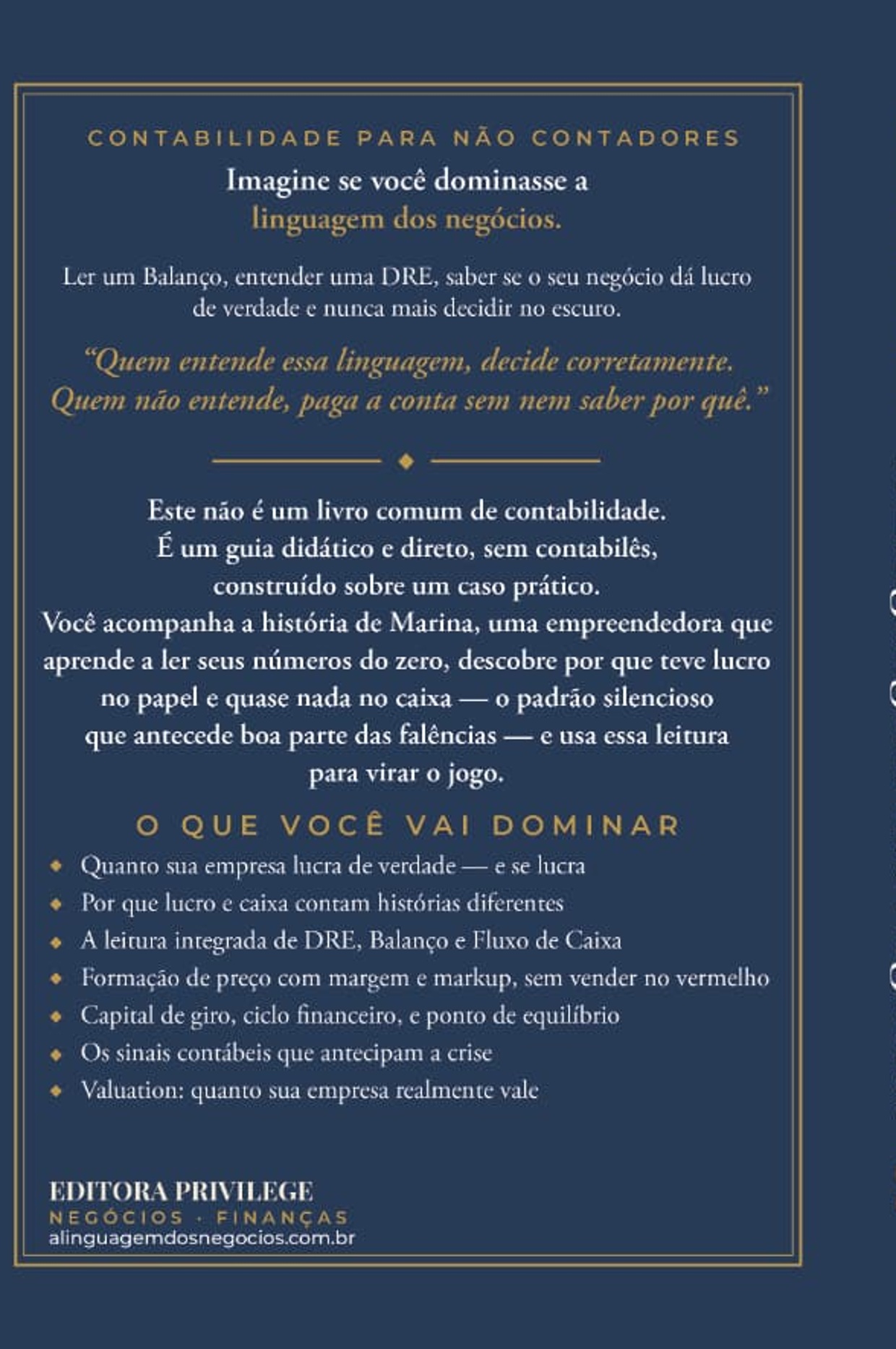
Read a balance sheet, understand an income statement, know whether your business is truly profitable — and stop relying on someone else's explanation to make decisions.
accounting without jargon, so you can easily understand your business results
Whoever understands this language makes the decisions. Whoever doesn't ends up paying the price — without even knowing why.
The book is now on sale · Choose between the physical or digital version · 7-day guarantee
Email notification No spam Special launch pricing
get to know the character at the heart of our story
She sold well. She worked hard. And still, at the end of the month, barely anything was left.
This isn't a boring accounting book full of legal and technical jargon. Its goal is to be an educational and enjoyable read that teaches you essential topics crucial to your business's success, through a practical case study.
Available now
Choose your version
The book is now on sale. Choose between the physical or digital version and start reading right away.
"The book is written in easy-to-understand language, for beginners interested in the subject, business owners who need to learn more about controlling their business, and people curious about the importance of accounting in everyday business."
M
Marcelo Pelucio
Verified review on Amazon
Common questions
Marina knew what she was doing.
She knew the product, knew her customers, knew how to serve them well. That's why, one day, she decided to quit her job and start her own business.
And at first, it worked out. Sales came in, customers kept coming back, the phone never stopped ringing. It seemed like she'd nailed it.
But over time, something started to shift. The business was growing, yes — but it got heavier to run every day.
There wasn't enough time. There wasn't enough organization. And deep down, she didn't really know where the money was going.
She sold, served customers, handled supplier issues, replied to clients on WhatsApp in the middle of the night. She did it all. And whenever there was time left over, it went toward putting out fires.
As for actually thinking about the business, she barely did that anymore. She was running on autopilot.
Until some uncomfortable questions started to surface, the kind nobody likes to face:
— Am I actually making money, or just passing it through my hands?
— Where is everything I bring in actually going?
— If I grow more, will things get better or worse?
And her problem wasn't lack of effort, far from it. She worked way too hard. The problem was something else: she understood the product, but she didn't understand her own business.
And that's exactly where most business owners get stuck.
We start a business because we know how to do something well — cut hair, sew, sell clothes, cook, fix things. And we mistake that for knowing how to run a company. It's not the same thing. And by the time it sinks in, there's usually already debt involved.
This book is about that. It tells the story of Marina — a business owner like so many others, hardworking, dedicated, but lost in her own numbers — and uses her case to show something almost nobody explains properly:
how to read your own business through its numbers.
No academic jargon. No giant spreadsheets. Just a conversation.
In practice, you'll come to understand:
— why some companies sell a lot and still go under
— where the money disappears to, even when the cash register looks full
— and how small, everyday decisions change the outcome of the whole year
Because at the end of the day, the difference between a company that succeeds and one that fails almost never lies in the product. It lies in how the owner sees — or fails to see — its numbers.
And if this story sounds familiar, that's because it is. It happens all the time, to good people who work hard, sell well, and still, at the end of the month, have almost nothing left in their pockets.
Marina — trying to make sense of the numbers
And that's exactly what happened to Marina. She had customers, she had demand, she had the skill. But she also had a problem she didn't even know she had:
she thought revenue meant profit.
To her, a good month meant high sales. Until the day she calmly looked at her bank statement and noticed something strange — the money wasn't keeping up with how much she was working.
Rising costs, expenses out of place, a squeezed margin. And that question every business owner eventually asks herself:
"If I'm selling so much, why isn't anything left?"
That question is the turning point for the business. Because it's when Marina stops just running the company and actually starts looking at it.
Are you making money, or just working a lot?
Accounting isn't a tax filing exercise. It's the language of business. It's the language of power.
Master the language of business
A story you'll want to read in one sitting
In the following pages, you'll follow Marina as she tries to get her house in order. Looking at the numbers, doing the math, understanding where the money is going — and why it's going there.
Chapter by chapter, she learns things no one taught her when she started her business. Simple, everyday things that change the way she makes decisions.
And so the question remains:
Will Marina pull it off?
Will she turn things around, get the company organized, and finally start making real money? Or will she discover, after finally doing the math right, something worse — that the way things are set up, this business simply doesn't add up?
The answer is in the final pages. And, honestly, it says a lot more about your business than about hers.
Signs that you still don't speak your business's language
Sales were good, but nothing was left over
High revenue, and yet cash was tight by the end of the month.
Didn't know if the business was profitable
Looked at the bank statement and couldn't tell if the business was in the black or in the red.
Relied on the accountant
Only understood their own numbers when someone explained them — and still had doubts.
Feared growing only to go bankrupt
Every expansion decision felt like a guess, with no financial security.
Why this book exists
It's not the worst products that go under. It's the best ones, in the hands of owners who don't understand their own numbers.
In nearly three decades advising companies — and years working in corporate restructuring — I learned an uncomfortable truth: it's not the worst products that go under. It's the best products, in the hands of business owners who don't understand their own numbers.
They were restaurant owners who didn't know how to calculate the cost of a dish. Manufacturers who had no idea what their own financial cycle looked like. Service providers and retailers who confused revenue with profit — and withdrew more from the company than it generated, month after month, without realizing it.
Financial ignorance is the greatest risk a company faces — and the only one that can be completely eliminated with information.
This book was also born from a desire to give business owners something that almost always arrives too late: clarity before urgency. It brings together everything I wish I could teach — and everything I wish my clients had learned before needing to file for judicial reorganization or, worse, shutting their doors too soon.
This book won't turn you into an accountant. That was never the goal.
What you'll be able to do by the end
→Understand the Balance Sheet and its components: Assets, Liabilities, and Equity.
→Read an Income Statement and recognize Gross Revenue, Net Revenue, Costs, Expenses, COGS, Gross Profit, EBIT, EBITDA, Operating Margin, Net Income, and Net Margin.
→Understand Cash Flow and the ratios that measure a business's health: current ratio, quick ratio, net working capital, working capital need, treasury balance, overall debt ratio, interest coverage, net debt/EBITDA, ROA, ROE, and the DuPont method.
→Master the Operating Cycle, Cash Conversion Cycle, Break-Even Point, Contribution Margin, and Working Capital, integrating them into a full reading of the financial statements.
→Recognize the accounting warning signs of a crisis before it hits, with practical financial management tools and an accessible introduction to valuation.
Bonus
How to evaluate the best tax regime (Presumed Profit, Actual Profit, and Simples Nacional), 30 strategic questions to ask your accountant, estate planning for the business's long-term continuity, an introduction to analyzing publicly traded companies, and access to an exclusive online Workbook at alinguagemdosnegocios.com.br — where the Bonus 2 calculations are done automatically using your own business numbers.
When business owners learn to control the business, they stop being controlled by it.
They start deciding with more clarity, acting before urgency hits, and making room for what also matters — family, leisure, hobbies, and life itself.
The book is on sale · Physical or digital version · 7-day guarantee
"Almost half of the businesses that close in Brazil don't fail for lack of sales. They fail because the owner doesn't understand their own business's numbers."
— Sebrae Research, 2025
You might recognize yourself here
You work the whole month. At the end, you check the cash and think: where did it go?
It's not lack of effort. It almost never is. It's that no one ever taught you how to read what your own company is trying to tell you.
💸
"I sell, but the money disappears"
The month closed strong, but cash is tight again. And you don't really know where it went.
⚠️
That fear that never goes away
Fear of not paying a supplier, of falling behind on payroll, of needing an overdraft. You don't say it out loud, but you feel it.
🔄
Living in firefighting mode
Money runs low, you scramble. Money comes in, you breathe. Then it tightens up again. And you're always chasing it.
📊
Deciding by guesswork
The accountant sends the income statement, you open it, close it, and file it away. You set prices by feel, hire under pressure, and invest on courage alone.
⚖️
Profit on paper, no cash in hand
The classic one: "if I'm making a profit, why isn't there any cash?" There's an explanation. And it matters a lot.
🧠
That exhaustion that never lifts
Decision after decision, all the time. And deep down that nagging doubt: "am I even doing this right?"
What changes in your routine
This isn't about becoming an accountant. It's about you no longer losing money without noticing.
Six things that change once you close the last page.
🔍
Find out where the money is leaking
Hidden costs, unnecessary expenses, poorly calculated margins. You start seeing the leaks that were right under your nose.
🧭
Decide on data, not on gut feeling
Pricing, hiring, investing. Move from "I think it'll work" to "the numbers show it will (or won't)."
📈
Earn more without having to sell more
Adjust pricing, cut what isn't needed, tighten operations. Take the effort you're already putting in and turn it into money.
⚠️
See the problem before it becomes a crisis
Shrinking margins, drying cash, signs of pressure. You'll see it coming — and act before it knocks you down.
🏦
Get off the bank's leash
Understand cycles, terms, and cash. Make the business sustain itself through its own operation, instead of living off a revolving credit line.
😌
Sleep better
Step out of firefighter mode. Stop just reacting. Less tightness in your chest, more sleep at night.
The deal
By the time you close the last page, you'll be able to look at your company's numbers, understand what they're telling you, and decide with more confidence — even if you never went to accounting school.
What you'll find inside
14 chapters, 5 practical bonuses, and a glossary of 80 terms you'll finally stop pretending to understand — all woven together through Marina's story, no fluff.
PART IThe Fundamentals
01
The Logic of Numbers
How to move past a standalone number and start using it to actually make decisions.
02
Accounting Standards — The Grammar of Accounting
The standards that organize accounting — and that every business owner should know.
03
Double-Entry Bookkeeping
The golden rule behind all of accounting: for every debit, a credit.
04
The Balance Sheet
A snapshot of the company on a given day: what it owns, what it owes, and what's left over. No mystery.
PART IIThe Financial Statements
05
Income Statement
The movie of the month — and where EBITDA actually shows up, within the staircase from revenue down to profit.
06
Costs and Expenses
The distinction that shapes your pricing — and why confusing the two eats into your margin.
07
Statement of Cash Flows
The pulse of the business: why profitable companies go under and how to avoid that fate.
PART IIIManagement and Metrics
08
Managerial Accounting
Liquidity, debt, margins, efficiency, and returns — the 7 metrics no business owner can afford to ignore.
09
Operating and Cash Cycles
How long your money stays tied up between buying, producing, and collecting payment.
10
Break-Even Point and Working Capital
How much you need to sell to avoid losing money — and how much cash you need on hand to operate.
11
Integrated Reading of Financial Statements
How to cross-reference the Balance Sheet, Income Statement, and Cash Flow Statement to see what no single report shows on its own.
PART IVStrategic Decision-Making
12
Accounting Warning Signs of a Crisis
The 8 warning signs that appear in the numbers before a company heads into judicial reorganization.
13
Practical Financial Management Tools
Monthly financial meetings, dashboards, and accounts-receivable aging to put into practice every day.
14
Basic Valuation
How much is your business worth? EBITDA multiples, discounted cash flow, and asset-based valuation.
Supplementary Material5 Practical Bonuses
Updated 2026Special Appendix
Tax Regimes and Their Impact
Simples Nacional, Presumed Profit, and Actual Profit — which costs your business less. Updated with the rules in effect for 2026.
Coming soon
Bonus 1
30 Questions for Your Accountant
The script to sit down with your accountant and finally ask the right questions.
Bonus 2
Practical Workbook
5 exercises to calculate your company's costs, break-even point, cash cycle, dashboard, and valuation.
Bonus 3
Holding Companies and Estate Planning
When it makes sense to set up a holding company and what the real tax impact is.
Bonus 4
Fundamental Analysis
How the same reasoning used to evaluate publicly traded companies can evaluate yours.
Chapter by chapter
Every pain point a non-accountant feels, a chapter that solves it.
On the left, the pain you recognize. On the right, the part of the book that gets you out of it.
Ch. 1 — The Logic of Numbers
"I look at my accountant's report and have no idea what to do with it."
→ You'll read numbers like a scoreboard: you'll know if you're winning, losing, and why.
Ch. 4 — Balance Sheet
"I assume the company is doing well because there's money in the account."
→ See what's really yours, what's disguised debt, and what the company is worth today.
Ch. 5 — Income Statement
"I'm selling a lot, but I don't know where the money is going."
→ Climb the staircase from revenue to profit and find out on which step the money disappears.
Ch. 6 — Costs and Expenses
"I price by guesswork, copying the competitor."
→ Learn to price with a real margin — without working for free while thinking you're profitable.
Ch. 7 — Cash Flow
"I show a profit on paper, but I'm always tight at the bank."
→ Understand why profitable companies go under and how to protect your cash before the squeeze.
Ch. 8 — Management Indicators
"I don't know if my business is healthy or sick."
→ The 7 indicators that work like a blood test for your company — and how to read them.
Ch. 10 — Break-Even Point
"I don't know how much I need to sell to avoid a loss."
→ Find the exact number that separates breaking even from losing money every month.
Ch. 12 — Warning Signs
"By the time I notice the business is sinking, it's already too late."
→ The 8 accounting warning signs that show up months before the crisis — and how to react.
Ch. 14 — Valuation
"I have no idea what my company is worth."
→ Calculate your business's value with 3 practical methods — no consultant required.
Ch. 11 — Tax Regimes
Simples, Presumido, or Real: which pays less tax in your case?
Enter your revenue, activity, and costs — the workbook compares the three regimes and shows how much you save per year.
Coming soon
Exclusive reader bonus
Online workbook — calculate your business numbers on the spot
No need to download a spreadsheet or build formulas. Open your browser, enter your numbers, and the workbook gives you price, margin, break-even point, cash conversion cycle, and valuation — all tied to the book's chapters.
✓Unlocked at launch, together with the book
✓Works on phone, tablet, or computer
✓Your data is saved so you can revisit it whenever you want
Senior attorney with over 28 years of experience in corporate advisory, focused on judicial reorganization, corporate restructuring, turnaround, tax law, and corporate law.
Having firsthand experience with the difficulty of interpreting financial statements to serve his clients, he completed an Accounting Technician program, followed by a Bachelor's degree in Accounting Sciences and his CRC registration.
Working in judicial reorganization, he realized that most companies don't fail for lack of money — they fail for not understanding the numbers. Inspired by the book The E-Myth by Michael Gerber, he decided to create this essential guide.
Academic Background
Accounting Technician CertificateBachelor's in Accounting Sciences (UNIP)Postgraduate in Tax Law (UNIVEM)Postgraduate in Constitutional Law (ESDC)MBA in Tax Law and Tax Management (ITE)MBA in Investments and Private Banking (IBMEC)MBA in International Instruments for Estate and Succession PlanningSpecialization in Corporate Turnaround (FGV)Training as Judicial Administrator (TMA)Turnaround Course (FIA)Training in Family Holding Structures (FIPECAFI/EAC-FEA-USP)
Active Bar License — 28+ yearsActive CRC (Accounting) License
What people are saying
Amazon reviews
5.0 out of 5 stars · 14 verified reader reviews
August 30, 2026
The definitive translator between operations and finance
This book's great virtue is demystifying accounting, taking it out of the “bureaucratic obligation” box and raising it to its real role: the most strategic decision-making tool. The author builds a perfect bridge between theory and practice, guiding the reader logically — from reading an income statement to the complexity of valuation.
— Cleber Costa
August 25, 2026
Excellent read!
A Linguagem dos Negócios is a very interesting and practical book, especially for those who need to better understand the numbers of their own business and improve how they communicate with the corporate world. A book that adds knowledge in a light and objective way.
— Renata de Oliveira Miranda Fernandes
August 25, 2026
Easy-to-understand language
The book is written in easy-to-understand language, for beginners interested in the subject, business owners who need to learn more about controlling their business, and people curious about the importance of accounting in everyday business.
— Marcelo Pelucio
August 30, 2026
Understand your company's cash flow!
I had the pleasure of meeting the author; he brings all his accounting expertise in a simple and didactic way to help us better understand our company's cash flow, ideal for anyone who wants to start a business.